Commodifying Japan
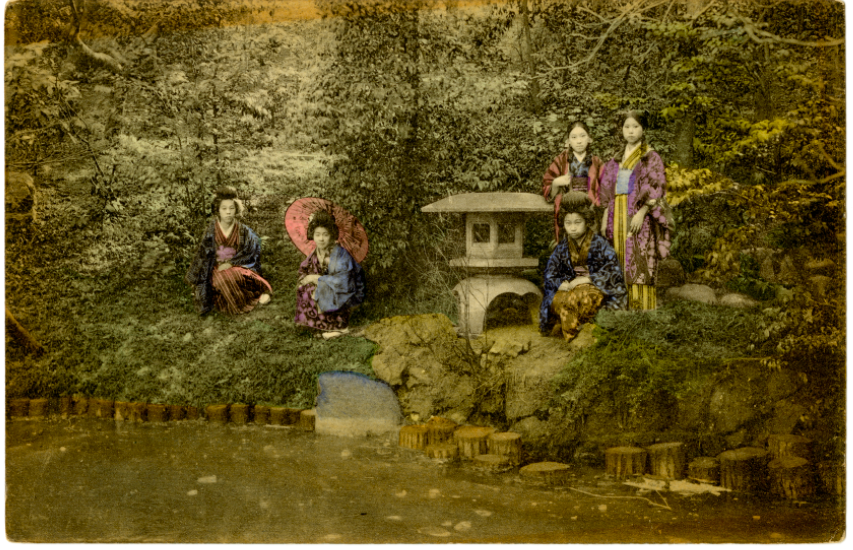
Postcards and the Process of Othering
At the turn of the century, postcards became associated with travel, depicting ‘exotic’ lands, cultures, and people. For many in Western civilizations, these postcards were their first interactions with cultures that were different from their own, reinforcing the process of ‘othering’ that had been taking place as a result of imperialism and nineteenth century colonialism. ‘Exotic’ cultures effectively became commodified in this process. The images of the cultures became a symbol of class through the collecting of ethnographic postcards in order to demonstrate one’s worldliness and ability to travel abroad– the cultures became a commodity and the Westerners became a consumer.
Orientalism & Exoticism
Edward Said’s Theory of Orientalism discusses the exaggeration of differences in the context of the presumption of Western superiority, looking specifically at inaccurate cultural representations. Cultures are reduced in the process of colonization in order to become more palatable to their Western audiences.
In the case of postcards, as Western individuals came to associate cultures with the pictures on the postcards, the foreign communities were reduced to two-dimensional archetypes, losing all nuance to their culture in the eyes of the Westerner. Consequently, ideas, cultures, and histories can never be fully grasped nor understood by the West because the ideas of the Orient, here used by Said to describe non-Western cultures, were presented as drastically different from their own. The postcard served as another archetype that Westerners could own as their own physical property, reinforcing the colonial mindset that the East was something to be collected and commodified rather than understood.
Exploiting the Image of the East
To Westerners, the ‘Orient’ exists as a figment of their imagination, a collection of stereotypes that connotes exoticism, passivity, and inferiority. The image of the East is exploited for the benefit of the West, a concept that is embodied in the selling of ethnographic postcards.
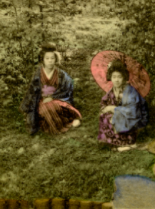
Asian women experience this fetishization two-fold, as both a woman and a person of color. In this particular postcard, the five girls stand in the middle of a garden, peering at the viewer behind greenery. The bright colors of their kimonos make them stand out but they are not framed in the photograph as individuals, almost serving as decoration to the scene.
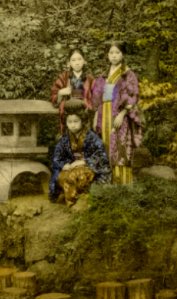
The girls are like exotic flowers in the garden; they are not the subjects of the photograph, but rather the object. The ethnographic postcard exists as a way for the West to consume the aesthetics of a foreign and exotic culture without having to do any of the work– they do not have to travel to a new place, interact with the people of the culture, or learn any of the customs. Instead, they can simply go to a store and buy a postcard that depicts this culture in order to convince their peers that they are well-traveled and cultured.
Consequences
Ethnographic postcards utilize the aesthetics of foreign cultures and the label of exotic to the benefit of the West, while exploiting the cultures of the East. The process of ‘othering’ allows the West to disassociate themselves from the process of colonization and prevents them from ever truly understanding the cultures they are captilizating off of. Cultural exploitation and the West’s imagination of these cultures reduces entire communities down to a few symbols that are mass produced and marketed to the West, creating and reinforcing harmful narratives of exotic stereotypes and Western dominance in the process.
